The Ultimate Guide to the SDLC

The Complete and Ready-To-Adapt System Development Life Cycle

  • Home
  • SDLC Principles
  • Articles
  • Table of Contents
  • Downloads
You are here: Home / Search for ""

Search Results for:

Articles

Legend of the Chicken and Pig

By Victor M Font Jr 1 Comment

Chicken and the Pig Legend
Photo by Juan Lacruz
Licensed under the Creative Commons Attribution-Share Alike 3.0 Unported license.
The Scrum framework consists of Scrum Teams and their associated roles; Time-Boxes, Artifacts, and Rules. Every Scrum team has a ScrumMaster responsible for making sure Scrum practices are followed and impediments to progress removed. The ScrumMaster does not manage the team. Teams are self-organizing with no more than 7 members. There is a Product Owner representing the customer to ensure the team addresses priorities from a business perspective. The Product Owner sits with the team. Team members are called “pigs” and everyone else is called “chickens.” The pig and chickens idea originated from a fable. The earliest written version I could dig up is from June 13, 1950 published in the Titusville, Pennsylvania Herald in the column “Try and Stop Me” by Bennett Cerf, pg. 4, col. 4. Cerf said:

A hen and a pig were sauntering down the main street of an Indiana town when they passed a restaurant that advertised “Delicious ham and eggs: 75¢.”

“Sounds like a bargain,” approved the hen. “That owner obviously knows how to run his business.”

“It’s all very well for you to be so pleased about the dish in question,” observed the pig with some resentment. “For you it is all in the day’s work. Let me point out, however, that on my part it represents a genuine sacrifice.”

Schwaber and Southerland¹ use a variation of this fable to illustrate two types of project members. Pigs are totally committed to the project and liable for its outcome. Chickens consult on the project and are informed of its progress. Chickens do not tell pigs what to do. By implication, a rooster is defined as a person who struts around offering uninformed and disobliging views. We all know a few roosters, don’t we?

¹Ken Schwaber and Jeff Southerland formerly presented Scrum as a software development approach at the International conference on Object-Oriented Programming, Systems, Languages and Applications 1995

The Dual Vee

By Victor M Font Jr Leave a Comment

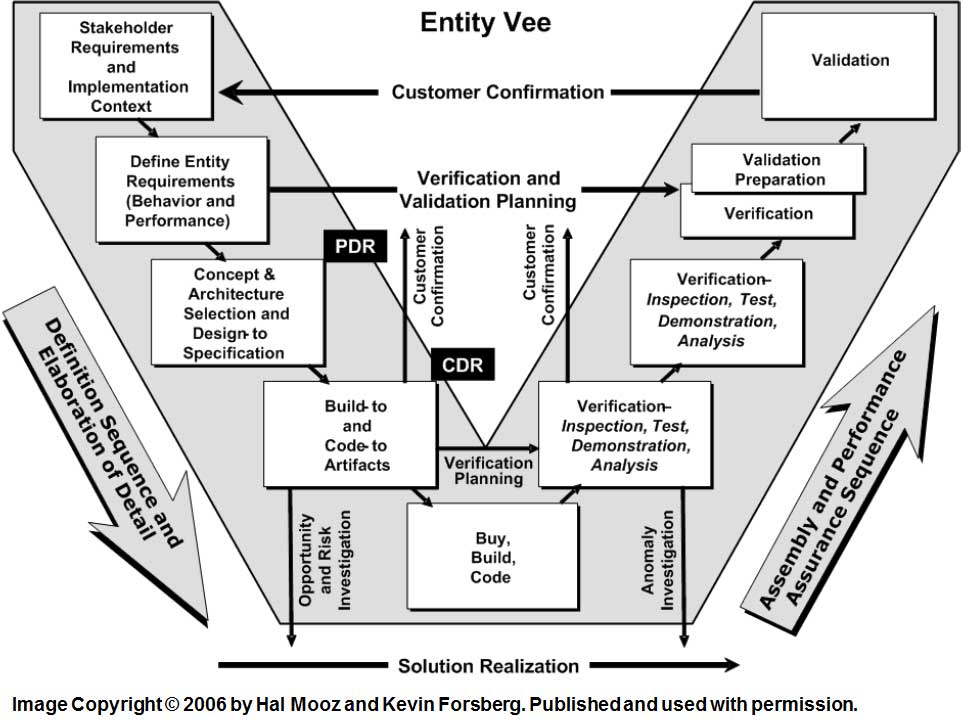
Forsberg & Mooz Dual Vee
Source: Forsberg & Mooz (2006) – Used with Permission
Recognizing insufficiencies with all Waterfall based models including their own Vee-Model, Forsberg and Mooz continued to refine their thesis. They presented a Dual Vee-Model in a 2006 paper titled “The Dual Vee – Illuminating the Management of Complexity.” In the abstract they said:

The Waterfall, Spiral, and Vee models are reminder models that guide us to less perilous paths when developing solutions to problems. Dr. Royce’s Waterfall (Royce 1970) provides an orderly approach to software development. Dr. Boehm’s Spiral (Boehm 1988) provides emphasis on solving known software risks before proceeding with Royce’s Waterfall. The Forsberg/Mooz Vee Model (Forsberg 1991) embraces full systems development by including details of integration, verification, and validation and opportunity and risk management in the symmetry of the Vee development sequence. However, all of these single solution development models fail to address the necessary concurrent development of a system’s architecture with the entities of that architecture.

While the original Vee-Model allowed for off-core concurrent engineering, the Dual Vee moves those off-core activities into core processes. In discussing the shortcomings of the Waterfall variants, they said:

“All of these popular development models, while quite accurate in their contributions to solution development, fail to adequately address the real life challenges of concurrently developing the system’s architecture while at the same time creating the architecture entities that are in various stages of their development especially when COTS, NDI and new development are all part of the architecture. Since our original Vee model did not clearly provide this aspect we have developed the Dual Vee…”

The Dual Vee Model recognizes two types of system development maturation in an Architecture Vee and an Entity Vee. The system architecture is defined as a “complement of entities that are to be realized at all architecture levels.” Entity development is “the creation of each entity within the architecture complement.” These two Vee models represent separate but concurrent paths that intersect at various points along the development life cycle culminating in system realization.

In concluding their paper, Forsberg and Mooz said, “Development of systems and system of systems requires the concurrent development of complex architectures and the entities of those architectures. A model has been needed to depict the required multi aspect decisions required to ensure correct and progressive development of both architecture and entity baselines. The Dual Vee Model offers the features of concurrent development, in parallel opportunity and risk management, integration, verification and validation planning, and anomaly resolution. It is a comprehensive reminder model that can remind us of our industry’s best practices, if we allow it to.”

US Vee Model

By Victor M Font Jr 2 Comments

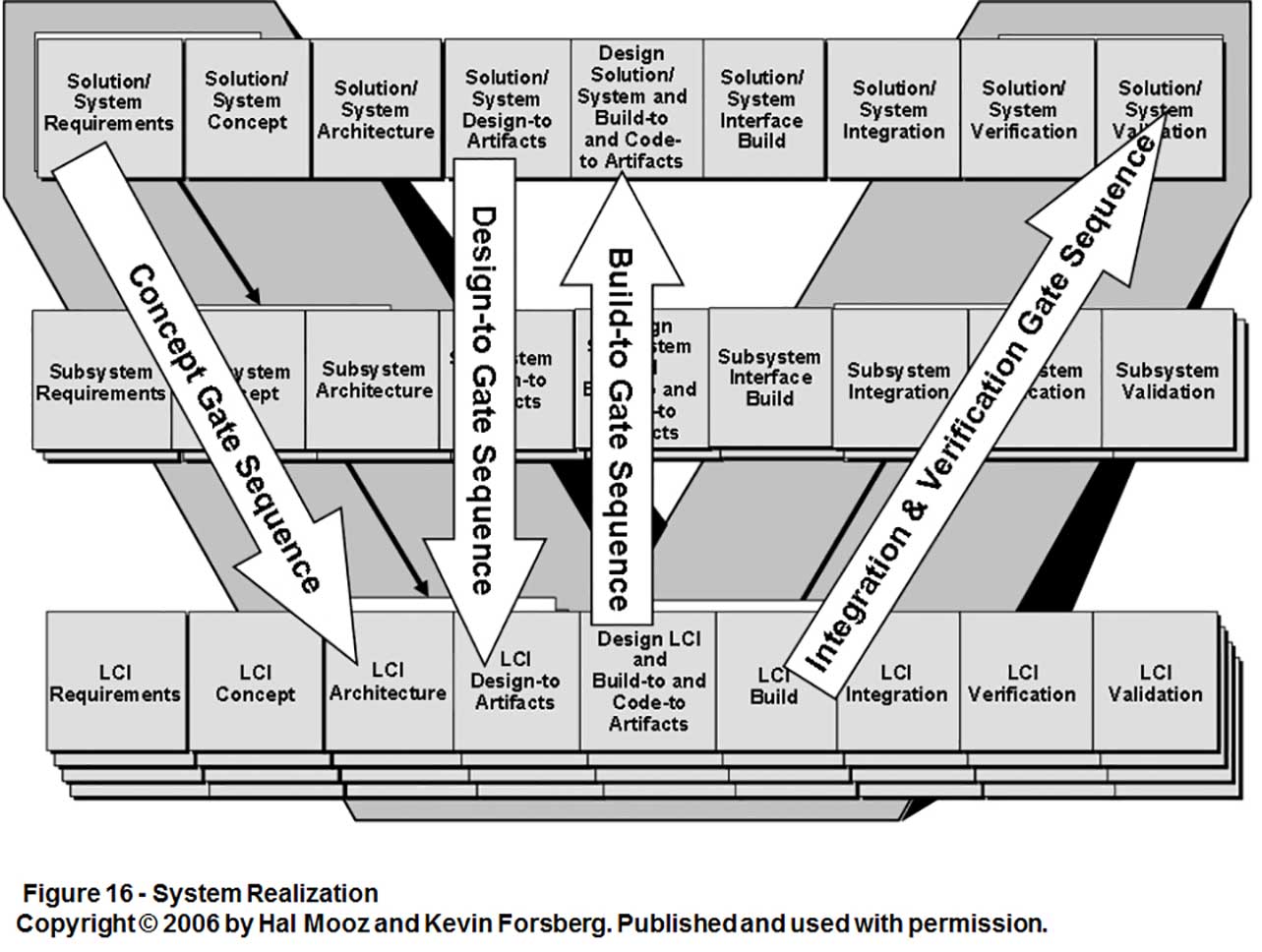
US Vee System Realization
Forsberg & Mooz System Realization – Used with Permission
The US Vee-Model was first discussed at a joint conference sponsored by the National Council on Systems Engineering (NCOSE) and American Society for Engineering Management (ASEM) in Chattanooga, TN on October 21–23, 1991. A paper named “The Relationship of System Engineering to the Project Cycle” written by Dr. Kevin Forsberg and Harold Mooz, Co-Principals for the Center for Systems Management, formerly of Cupertino, California, now located in Vienna, Virginia. The paper was also presented at The 12th INTERNET World Congress on Project Management held in Oslo, Norway on June 9–11, 1994.

Both Forsberg and Mooz are involved in the aerospace industry. At the time of the document, Forsberg had 27 years of experience in Applied Research, System Engineering, Program, and Proposal Management, followed by seven years of successful consulting to both government and industry. He received the NASA Public Service Medal for his contributions to the Space Shuttle program. Mooz had 22 years of experience in System Engineering and Program Management, followed by ten years of successful consulting to government and industry. Mooz has won and successfully managed highly reliable, sophisticated satellite programs from inception to operations. It’s a fascinating coincidence that both the German and US V-Models were parented by the aerospace industry.

Forsberg and Mooz believe their Vee-Model addresses the system engineering deficiencies of Linear Waterfall, Modified Waterfall and DOD-STD-2167A, the immediate successor to DOD-STD-2167. They mention Boehm’s Spiral Model in their paper and say, “While Boehm’s spiral representation (Exhibit 4) achieves his objective, the system engineering role is still obscured.” The “(Exhibit 4)” in the quote refers to an image of Boehm’s model reproduced in their document.

As all the other models we’ve discussed thus far, the Vee-Model is Waterfall based with notable exceptions. They said, “In our approach, the technical aspect of the project cycle is envisioned as a “Vee,” starting with User needs on the upper left and ending with a User-validated system on the upper right.” Notice the deliberate use of the word “user” implying end users are involved in all aspects of the development cycle.

The model recognizes the changeability of requirements and provides for the establishment of six baselines: User Requirements Baseline, Concept Baseline, System Performance Baseline, “Design-To” Baseline, “Build-To” Baseline and “As-Built” Baseline. The process is iterative and allows for incremental development and concurrent engineering within any phase until that phase’s stage review. After a stage review successfully completes, a new phase is initiated and the old phase is not revisited as in the Waterfall design. Major emphasis is placed on Verification and Validation activities, risk identification and risk reduction modeling. Verification and validation mean that all requirements are testable and agreed to by the stakeholders. We’ll discuss verification and validation in detail in the requirements chapters.

The Forsberg and Mooz Vee-Model consists of nine phases:

  • Understand user requirements, develop system concept and validation plan
  • Develop system performance specification and system verification plan
  • Expand system performance specification into CI “Design-to” specifications and CI verification plan
  • Evolve “Design-to” specifications into “Build-to” documentation and inspection plan
  • Fabricate, assemble and code to “Build-to” documentation
  • Inspect to “Build-to” documentation
  • Assemble CIs and perform CI verification to CI “Design-to” specifications
  • Integrate system and perform system verification to performance specification
  • Demonstrate and validate system to user validation plan

Much of the risk analysis and concurrent systems engineering occur in “off-core” activities. Forsberg and Mooz said, “While technical feasibility decisions are made in the off-core activities only decisions at the core-level are put under Configuration Management at the various Control Gates. Off-core activities, analyses, and models are performed to substantiate the core decisions and to ensure that risks have been mitigated or determined to be acceptable.”

A Funny Thing Happened on the Way to the V-Model

By Victor M Font Jr 1 Comment

Forsberg & Mooz (2006) - Used with Permission
Forsberg & Mooz (2006) – Used with Permission
In the late 1980s two countries, Germany and the United States, simultaneously but independently developed a V-Model. While the two models are similar in concept, they differ enough to be considered alternative approaches. The German V-Modell was developed in part by IABG in Ottobrunn, near Munich in cooperation with the Federal Office for Defence Technology and Procurement in Koblenz for the Federal Ministry of Defence. IABG was founded in 1961 as a central analysis and testing organization for Germany’s aeronautics industry and the Ministry of Defence. Their focus was aeronautics industry testing and security and defense analysis. Today, IABG is a leading European technology and science service provider and is involved with the Airbus development programs.

Development of the V-Modell occurred over a 4-year period beginning in 1986. Pilot project trials started in early 1990. It was made obligatory for the defense area by the Federal Ministry of Defence in February 1991. The V-Modell proved so successful in Germany’s defense industry that in the summer of 1992 it was taken over by the Federal Ministry of the Interior for the civilian public authorities domain to provide a uniform systems development standard for the whole range of public authorities. With the publication of the “Development Standards for IT Systems of the Federal Republic of Germany” in 1997, the V-Modell 97 entered into force as the standard for all civil and military federal agencies. It was used throughout Germany by banks, insurance companies, car manufacturers, the manufacturing industry and energy producers.

The V-Modell gained traction in Europe. An English translation was completed for use in international projects. It is the subject of a European Commission (EC) project started in 1989 with the goal of surveying software engineering methods and harmonizing them. The German representative to the EC Committee is the Federal Ministry of the Interior. In view of the Ministry’s own use of the V-Modell, it was nominated as the German standardization contribution at the European level.

The German V-Modell was structured into four functional parts called submodels. The submodels are:

  • Software Development (SWD)
  • Quality Assurance (QA)
  • Configuration Management (CM)
  • Project Management (PM)

These four are closely interrelated and mutually influence one another through the exchange of products/results. Since the focus of our SDLC is systems development, let’s decompose the software development submodel. The submodel comprises the following nine primary activities:

  1. System Requirements Analysis and Design:
    1. Describes the system requirements its environment
    2. Conduct a threat and risk analysis; develop a security concept
    3. Deliver a user level model of functions/data/ objects
    4. Structure the system into subsystems, segments or configuration items
  2. DP Requirements Analysis and Design
    1. Describe the DP segment requirements and its environment
    2. Development of a security model, structuring the segment into its SW and HW configuration items
  3. SW Requirements Analysis
    1. Describe the SWCI requirements and its environment
  4. Preliminary Design
    1. Structure the SWCI in SW components/modules/database, specification of the interfaces and interaction of its elements
  5. Detailed Design
    1. Describe the components and modules with respect to the real implementation of their functions, the data administration and error handling up to a programmig specification
  6. Implementation
    1. Convert the programming specifications to statements of the programming language
    2. Perform informal assessment of developed code and implementation of a database (if required)
  7. SW Integration
    1. Integrate modules to components and components to the SWCI
  8. DV Integration
    1. Integrate the different SW and HW configuration items to a DP segment
  9. System Integration
    1. Integrate the subsystems (if existing) and segments to the system

V-Modell 97 met with obsolescence in 2004. It no longer reflected the state-of-the-art of information technology and its use declined. New methods and technologies—as for example component-based development or the test-first approach—are considered only to a limited degree in V-Modell 97. It is superseded by “V-Modell XT,” completed in 2006. The V-Modell XT is a standard developed on behalf of the Federal Office of the Bundeswehr for Information Management and Information Technology and the Federal Ministry of the Interior, Central Office for Information Technology Coordination in the Federal Administration (BMI-KBSt).

  • « Previous Page
  • 1
  • 2
  • 3
  • 4
  • 5
  • 6
  • …
  • 12
  • Next Page »

Buy Now, Instant Download

The Ultimate Guide to the SDLC front cover
PDF eBook

$49.99

[add_to_cart id="1013" show_price="false" style="border: none;"]

Download Free Preview

[add_to_cart sku="SDLC-Pre" style="border: none"]

UltimateSDLC.Com is Hosted on SiteGround

SiteGround Web Hosting

Free Instant Download

The Ultimate Guide to the SDLC front cover
PDF eBook

$49.99 NOW FREE!

[add_to_cart id="1013" show_price="false" style="border: none;"]

Valuable Extra Content

Downloadable Content

When you purchase The Ultimate Guide to the SDLC, you also receive over 60Mb of valuable complementary content contributed by some of the world's most respected Information Technology experts such as: Dr. Barry W. Boehm, TRW Professor of … Read More

About the Author

Victor M. Font Jr., Author

Victor Font is an award winning author, entrepreneur and star performing global IT Executive with over a quarter century’ experience in application development, project management, business analysis, quality assurance and leadership. He is a founding member … Read More

Testimonials

Thank You for Your Testimonial

“…The author has truly “hit the nail on the head.” Whether you are an academic student who is aspiring to be an IT professional one day, a trainee that has just started career, a business & quality analyst and manager that has years of IT SDLC project experience—a must read for an IT professional at all levels of IT journey.” —Sekhar Bommana PMP, ITIL, VP – … Read More

Consulting Services

I have the prescription for your IT ailments

Implementing a SDLC is not an easy task. In fact, it can take months or even years to develop the policies, processes, procedures, metrics and training to bring you the kind of results that lead to repeatable project successes, reduced rework and deliverables that meet or exceed stakeholder expectations. There are a number of factors that … Read More

Copyright Notice

Copyright © 2010–2026 Victor M. Font Jr.
Unauthorized use and/or duplication of this material without express and written permission from this website’s author and/or owner is strictly prohibited. Excerpts and links may be used, provided that full and clear credit is given to Victor M. Font Jr. with appropriate and specific direction to the original content.

Recent Posts

  • Managing Scope Creep
  • Agile Manifesto
  • Adaptive Software Development
  • Incremental Commitment Model
  • Legend of the Chicken and Pig

Recent Comments

  • Teknik Fisika on Managing Scope Creep
  • Teknik Fisika on Incremental Commitment Model
  • Dawlat Waziri on The Project Management Method and the SDLC
  • Kuliah Terbaik on The 3-Legged Stool of IT Business Value
  • Victor M Font Jr on The Spiral Model

Tags

Affiliates Agile Best Practice Business Analysis Checklist Commission Elicitation Good Requirements Hybrid Hyrid IT Governance Model Organizational Change Outsourcing Project Management Quality Assurance Requirements Elicitation Risk Management SDLC Thought Provoking Waterfall Waterfall Variant

Return to top of page

Copyright © 2010–2026 Victor M. Font Jr.

Privacy Policy | Terms of Service | Contact Author | Report Erratum | Sitemap